From Leon Siu , March 3th, 2024
 The biggest obstacle to reinstating Hawaii as an independent country is UNGA Resolution 1469, adopted by the United Nations General Assembly on December 12, 1959. Resolution 1469 accepted a report it received from the United States that the people of Hawaii had voted to become the 50th State of the United States. Even though we know now that the “statehood referendum” was a complete sham, UNGA Resolution 1469 still stands, blocking the way to a free Hawaii.
UNGA Resolution 1469 gives international legitimacy to the United States’ claim of dominion and jurisdiction over the Hawaiian Islands. It stands today as the official position of the UN and its 193 member countries, effectively insulating the United States and the State of Hawaii, from legal challenges, liability and accountability for otherwise clearly unlawful acts against the Hawaiian nation since 1893.
When lawsuits are brought by Hawaiians against the US for the illegal overthrow or the illegal annexation or the illegal land grabs –– anything that argues the US’ unlawful jurisdiction –– the courts dismiss the cases by citing, “this is not a legal question, it’s a political question”. Usually left unsaid is… “and the political question has been settled”.
So, what settled the political question of Hawaii’s political status? The 1959 “statehood plebiscite”, which was actually a veiled and skewed UN referendum for decolonization. When the US reported to the UN that the people of Hawaii exercised their right to self-determination and overwhelmingly chose to join the US, the UN, without verifying whether or not the US report was truthful, extended its approval by adopting Resolution 1469, thus validating that the political question was settled: Hawaii had been absorbed into the United States. That is where we are stuck, and will remain stuck, unless Resolution 1469 is removed.
At the UN in New York (where this issue of Ke Aupuni Update is being written) we have been developing a strategy to remove the obstacle that is Resolution 1469. How? We are asking members of the UN General Assembly who are sympathetic to our cause, to submit a resolution to the General Assembly calling for a procedural review of the conditions and circumstances that led to their adoption of Resolution 1469 in 1959. It is simply a procedural review of an action by the UN, not a direct challenge to the UN or the US.
However, conducting such a review will quickly uncover the blatant fraud by the U.S. to con the UN General Assembly into erroneously adopting Resolution 1469. Upon discovering that error and realizing they are complicit in fraud and the prolonged illegal occupation of a peaceful and friendly sovereign nation (Hawaii), the UN General Assembly would then be categorically obligated to annul that flawed and offending resolution.
This would cause a 180-degree turnaround. Without UNGA Resolution 1469 to lean on, the United States’ claim to Hawaii collapses, and by default, the Hawaiian Kingdom, the sovereign nation in continuity, springs forward to be restored as the lawful governing entity over the lands and people of the Hawaiian Islands.
The removal of Resolution 1469 will also open the United States to legal challenges and judgements for the 131 years of criminal acts of piracy, pillaging and crimes against humanity, which would result in the United States not only withdrawing from our country, but providing massive restitution for crimes and damages.
But most importantly, it will mean the return of control of the assets, operations and governance of the Hawaiian Islands to the Hawaiian Kingdom and its Aloha ʻĀina…the people who love their country…
— Aloha ʻĀina —
“Love of country is deep-seated in the breast of every Hawaiian,
whatever his station.” — Queen Liliʻuokalani
(additional information from Geko)
Text of the UNGA Resolution 1469 from the December 12, 1959
1469 (XIV). Cessation of the transmission of
information under Article 73 e of the Char-
ter in respect of Alaska and Hawaii
The General Assembly,
Recalling that, by resolution 222 (III) of 3 Nov-
ember 1948, the General Assembly, while welcoming any
development of self-government in Non-Self-Governing
Territories, considered it essential that the United
Nations be informed of any change in the constitutional
status of any such Territory as a result of which the
responsible Government concerned thinks it unnecessary
to transmit information in respect of that Territory
under Article 73 e of the Charter of the United Nations,
Having received from the Government of the United
States of America communications dated 2 June 195938
and 17 September 195934 informing the Secretary-
General that Alaska and Hawaii, respectively, have, as
a result of their admission into the United States as
the forty-ninth and fiftieth States, attained a full meas-
ure of self-government and that, as a consequence of
this change in their constitutional status, the United
States Government would cease to transmit information
under Article 73 e of the Charter in respect of Alaska
and Hawaii,
H wing examined the communications of the Gov-
ernment of the United States of America in the light
of the basic principles and objectives embodied in
Chapter XI of the Charter and of all the other elements
of judgement pertinent to the issue,
Bearing in mind the competence of the General
Assembly to decide whether a Non-Self-Governing Ter-
ritory has or has not attained a full measure of self-
government as referred to in Chapter XI of the Charter,
1. Takes note of the opinion of the Government of
the United States of America that, owing to the new
constitutional status of Alaska and Hawaii, it is no
33 Jbid., Fourteenth Session, Annexes, agenda item 36, docu-
ment A/4115.
34 Jbid., document A/4226.
longer appropriate or necessary for it to transmit in-
formation under Article 73 e of the Charter of the
United Nations in respect of Alaska and Hawaii;
2. Expresses the opinion, based on its examination
of the documentation and the explanations provided,
that the people of Alaska and Hawaii have effectively
exercised their right to self-determination and have
freely chosen their present status;
3. Congratulates the United States of America and
the people of Alaska and Hawaii upon the attainment
of a full measure of self-government by the people of
Alaska and Hawaii ;
4. Considers that, owing to the circumstances men-
tioned above, the declaration regarding Non-Se!t-
Governing Territories and the provisions established
under it in Chapter XI of the Charter can no longer he
applied to Alaska and Hawaii;
5. Considers it appropriate that the transmission of
information in respect of Alaska and Hawaii under
Article 73 e of the Charter should cease.
855th plenary meeting,
12 December 1959.
The timeline of Statehood


June 14, 1900: Congress approved the Hawaii Organic Act. The Territory of Hawaii then developed its governing legislation, and the citizens of Hawaii were now U.S. citizens.
February 11, 1919: Jonah Kūhiō Kalanianaʻole presented a Hawaiian statehood bill to Congress. A committee studied the bill.
1921-1959: During this period, statehood for Hawaiʻi would be proposed to the House of Representatives forty-eight more times and face opposition. Opposing representatives from the Southern states were concerned that the representatives from Hawaiʻi would encourage civil rights legislation in Congress. For some of the opposing Democrat representatives, admitting a traditionally Republican state into the union could lessen the chances of the Democrats regaining control of the Senate. Some of the representatives from populous states didn’t want Hawaii to lessen their voting leverage. New York Representative Coudert argued that the bill would give Hawaiʻi one Senator for every 35,000 voters, when New York state has one Senator for every 2,500,000 people.
1935: The movement for statehood in Hawaiʻi accelerated, partially due to the possibility of a new tariff for the continental United States on sugar from Hawaiʻi and the possibility of military rule resulting from the community’s unrest from the controversial Massie case.
October 6 to 22, 1937: A joint congressional committee with seven senators and twelve representatives went through seventeen days of hearings in Hawaiʻi and determined that Hawaiʻi is eligible for statehood. From the hearings is a recommendation for a statehood plebiscite, or a vote in which people in Hawaiʻi approve or disapprove statehood.
November 5, 1940: The majority of Hawaiʻi voters voted in favor of statehood 46,174 to 22,426 votes in the statehood plebiscite, resulting in the required 2 to 1 vote.
January 7 to 17, 1946: The U.S. House Committee on Territories conducted hearings for Hawaiʻi statehood. On the last day, Territorial Senator Alice Kamokila Campbell delivered a speech against statehood, 53 years after the overthrow of the Hawaiian monarchy. She said, „I do not feel … we should forfeit the traditional rights and privileges of the natives of our islands for a mere thimbleful of votes in Congress…“
1946: The United Nations included Hawaiʻi in the United Nations List of Non-Self-Governing Territories, which also included Alaska, America Sāmoa, Guam, the Philippines, the Panama Canal Zone, Puerto Rico, and the U.S. Virgin Islands.
September 1947: Kamokila Campbell started the Anti-Statehood Clearing House, which went against the Hawaiʻi Statehood Commission efforts. She gathered testimonies against statehood, presented them to Congress, and sent information and arguments against statehood to Congress.
January 7, 1948: President Harry S. Truman encouraged Hawaiʻi statehood in his state of the union address.
January 17, 1948: Fifty-five years after the overthrow of the Hawaiian Kingdom, Territorial Senator Alice Kamokila Campbell filed a lawsuit against the Hawaiʻi Statehood Commission in the case Campbell v. Stainback et al. She questioned the territorial government’s use of $200,000 in public funds for the local and national campaign for statehood and argued that it was for political, rather than for public, purposes.
March 29, 1949: The case Campbell v. Stainback et al. concludes with Justice E. C. Peters ruling that the Statehood Commission should not be using public money to campaign for statehood.
May 20, 1949: The Territorial Legislature approved the assembling of the Constitutional Convention to develop a state constitution to accelerate the statehood process.
November 7, 1950: Hawaiʻi voters voted in favor of the Hawaii State Constitution with a vote of 82,788 to 27,109 votes.
1952: A combined Hawaii-Alaska Statehood bill went to the Senate floor, despite the objections from the delegates from Hawaiʻi and Alaska.
1953: The House of Representative approved the Hawaii Statehood bill 274 to 138, but the Senate delayed the measure until the next year.
1954: The Senate decided to combine the statehood bills for Hawaiʻi and Alaska together and passed the combined bill 57 to 28.
1957 to 1958: Hawaiʻi Delegate John A. Burns decided to follow the strategy of giving Alaska statehood and delaying statehood for Hawaiʻi. President Dwight D. Eisenhower wanted to give Hawaiʻi statehood, but was uncertain about giving Alaska statehood. However, the House of Representatives and the Senate passed the Alaska Statehood bill, and Eisenhower signed the bill.
March 11, 1959: The Senate voted in favor of the Hawaii Statehood Bill 75 to 15 votes.
March 12, 1959: The U.S. House of Representatives voted in favor of the Hawaii’s Statehood Bill 323 to 89 votes.
June 27, 1959: Hawaiʻi voters approved the Statehood bill 132,773 to 7,971 votes.
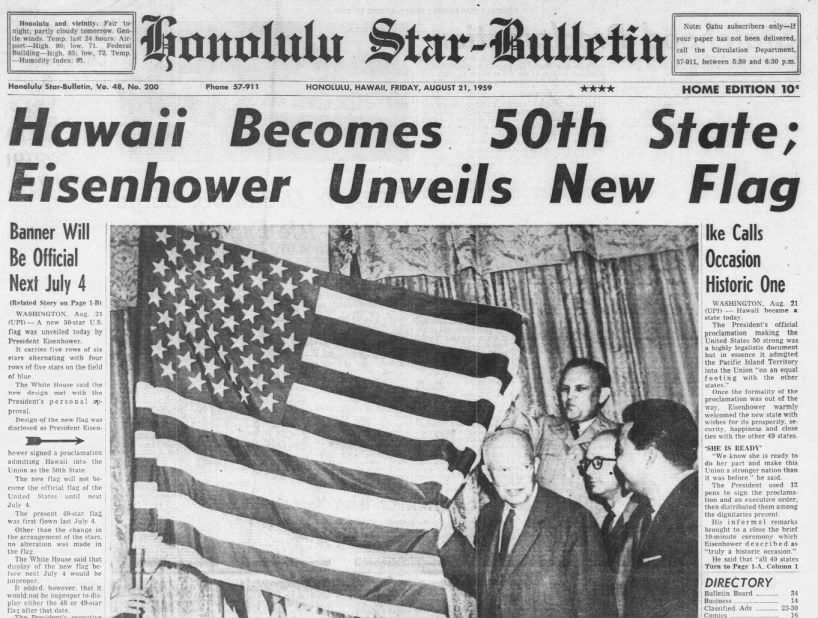
August 21, 1959: President Eisenhower signed the proclamation that welcomes Hawaiʻi as the fiftieth state.
September 17, 1959: After Hawaiʻi voters approved the statehood bill, the United States sent a letter to the United Nations Secretary General, saying that Hawaiʻi is now a State of the Union and that the United States will no longer report about Hawaiʻi to the United Nations. The United Nations removed Hawaiʻi from the list of non-self-governing territories.
November 23, 1993: U.S. President Bill Clinton signed the „Apology Resolution,“ formally known as United States Public Law 103-150, which apologizes on behalf of the United States for its role in the overthrow of the Hawaiian monarchy.
Suggested Search Terms:
1. [Try the following terms in combination, proximity, or as phrases using Search Pages in Chronicling America.] hawaii, statehood, kuhio, kalanianaole
2. Put “Hawaii Statehood” in the field “with all of the words”
3. Select Hawaii in the “Select state(s)” field and enter “statehood” as a search term
Sample Articles from Chronicling America:
Hawaiian Statehood, The Honolulu Republican (Honolulu, T.H.), July 14, 1900, Image 2, Col. 3
http://chroniclingamerica.loc.gov/lccn/sn85047165/1900-07-14/ed-1/seq-2/
No Statehood for Hawaii, The Honolulu Republican (Honolulu, T.H.), July 14, 1900, Image 2, Col. 3
http://chroniclingamerica.loc.gov/lccn/sn85047165/1900-07-14/ed-1/seq-2/
Delegate Wilcox Much Too Previous, The Honolulu Republican (Honolulu, T.H.), July 17, 1901, Image 1, Col. 7
http://chroniclingamerica.loc.gov/lccn/sn85047165/1901-07-17/ed-1/seq-1/
Ridicules the Idea of Statehood for Hawaii, The Honolulu Republican (Honolulu, T.H.), August 08, 1901, Image 1, Col. 4
http://chroniclingamerica.loc.gov/lccn/sn85047165/1901-08-08/ed-1/seq-1/
Hawaii and Statehood, The Honolulu Republican (Honolulu, T.H.), August 11, 1901, Image 4, Cols. 3-4
http://chroniclingamerica.loc.gov/lccn/sn85047165/1901-08-11/ed-1/seq-4/
Delegate Wilcox Impassionate Address to Hawaiians, The Independent (Honolulu, H.I.), July 10, 1902, Image 1
http://chroniclingamerica.loc.gov/lccn/sn85047097/1902-07-10/ed-1/seq-1/
Hawaii and Statehood, The Hawaiian Gazette (Honolulu [Oahu, Hawaii]), January 01, 1909, Image 4, Col. 1
http://chroniclingamerica.loc.gov/lccn/sn83025121/1909-01-01/ed-1/seq-4/
Must Wait for Our Statehood, The Hawaiian Gazette (Honolulu [Oahu, Hawaii]), July 26, 1910, Image 1, Col. 2
http://chroniclingamerica.loc.gov/lccn/sn83025121/1910-07-26/ed-1/seq-1/
Statehood for Hawaii, The Hawaiian Gazette (Honolulu [Oahu, Hawaii]), August 05, 1910, Image 4, Col. 2
http://chroniclingamerica.loc.gov/lccn/sn83025121/1910-08-05/ed-1/seq-4/
What Other Say of Statehood, The Hawaiian Gazette (Honolulu [Oahu, Hawaii]), September 30, 1910, Image 4, Col. 2
http://chroniclingamerica.loc.gov/lccn/sn83025121/1910-09-30/ed-1/seq-4/
Time to Campaign for Statehood Here, The Hawaiian star., January 11, 1911, SECOND EDITION, Page THREE, Image 3
http://chroniclingamerica.loc.gov/lccn/sn82015415/1911-01-11/ed-1/seq-3/
Hawaii and Statehood, The Hawaiian Gazette (Honolulu [Oahu, Hawaii]), March 24, 1911, Image 4, Col. 1
http://chroniclingamerica.loc.gov/lccn/sn83025121/1911-03-24/ed-1/seq-4/
Massachusetts Papers Howl at Idea of Hawaii Asking Statehood, Evening Bulletin (Honolulu [Oahu, Hawaii]), June 17, 1911, Image 15, Col. 1-3
http://chroniclingamerica.loc.gov/lccn/sn82016413/1911-06-17/ed-1/seq-15/
Hawaii Wants Statehood, The Washington Times (Washington [D.C.]), February 12, 1919, FINAL EDITION, Image 2, Col. 6
http://chroniclingamerica.loc.gov/lccn/sn84026749/1919-02-12/ed-1/seq-2/
Drive of Freedom Plan of Our Isles, The Washington Times (Washington [D.C.]), April 06, 1919, NATIONAL EDITION, Image 11
http://chroniclingamerica.loc.gov/lccn/sn84026749/1919-04-06/ed-1/seq-11/
More Information
- Rosulation Table UN General Assembly
- Resolution 1469 from the December 12, 1959
- Resolution 222 (III) November 3, 1948
- Hawaii Statehood, August 21, 1959 (Here is a small sampling of the many congressional records)
- University of Hawaii Library
 Traveling…

 Tales of Hawai'i