Go to:
| Treaty | Signer | more Infos |
History

While the 15 Year Napoleonic War was raging in continental Europe, The United Kingdom built a large Royal Navy that enabled the British Empire to become the world’s leading power in the next century. Great Britain swarmed the world with the fleet and occupied most of the French and Dutch overseas possessions. Napoleon therefore tried to isolate Great Britain and imposed a trade embargo against the country and even wanted to invade Great Britain. Napoleon’s plans, however, failed because of the inferiority of his navy. In 1805, Captain Nelson’s Royal Navy fleet decisively defeated the French Imperial Navy and the Royal Spanish Navy at Trafalgar, in what was the last significant naval action of the Napoleonic forces. For almost a century, from Napoleon’s final defeat at the Battle of Waterloo to the outbreak of the First World War, Britain was almost continuously at peace with the great powers. However, the United Kingdom engaged in extensive offensive military operations in Africa and Asia, such as the Opium Wars with the Qing Dynasty, to expand its overseas territorial holdings and influence.

During this period, Britain had the largest industrial capacity in the world, and its mastery of the seas enabled it to build significant economic power through trade with its possessions and the United States.
 The Industrial Revolution accelerated, textile factories were added by the iron and steel industry, coal mining, railways and shipbuilding. The second British Empire, founded after the loss of the Thirteen Colonies in the American Revolutionary War of the 1770s, expanded dramatically in India, other parts of Asia and Africa. During this period of peace, guaranteed by the overwhelming power of the Royal Navy, the United Kingdom experienced a period of reform, industrialization, progress. But amid prosperity and population growth, Ireland suffered one of the world’s worst famines in 1840, claiming over 1 million lives. During this time and in subsequent years, the starving lunatics emigrated to Great Britain and the United States. The emigration trend continued in Ireland for decades and Ireland’s population never recovered to pre-famine levels. British foreign policy avoided complicated alliances.
Vertrag zwischen Kingdom of Hawaii Und the United Kingdom of Great Britain und Ireland
MARCH 26TH, 1846.It being desirable that a general convention should be substituted for the various instruments of mutual agreement at present existing between Great Britain and the Sandwich Islands, the following articles have, for that purpose and to that intent, been mutually agreed upon and signed between the Governments of Great Britain and the Sandwich Islands, and it has been determined that any other Treaty or Conventional Agreement, now existing between the respective parties, shall be henceforward abrogated and considered null and of no effect:
ARTICLE I.
There shall be perpetual peace and amity between Her Majesty the Queen of the United Kingdom of Great Britain and Ireland, and the King of the Sandwich Islands, their heirs and successors.
ARTICLE II.
The subjects of Her Britannic Majesty residing within the dominions of the King of the Sandwich Islands, shall enjoy the same protection in regard to their civil rights as well as to their persons and properties, as native subjects; and the King of the Sandwich Islands engages to giant to British subjects the same rights and privileges which now are, or hereafter may be, granted to or enjoyed by any other foreigners, subjects of the most favored nation.
ARTICLE III.
No British subject accused of any crime whatever shall be judged otherwise than by a jury composed of native or foreign residents, proposed the British Consul and accepted by the Government of the Sandwich Islands.
ARTICLE IV.
The protection of the King of the Sandwich Islands shall be extended to all British vessels, their officers and crews. In case of shipwreck, the chiefs and inhabitants of the different parts of the Sandwich Islands shall succour them and secure them from plunder. The salvage dues shall be regulated, in case of dispute, by arbitrators chosen by both parties.
ARTICLE V.
The desertion of seamen embarked on board of British vessels shall be severely repressed by the local authorities; who shall employ all the means at their disposal to arrest deserters; and all reasonable expenses of capture shall be defrayed by the captains and owners of the said vessels.
ARTICLE VI.
British merchandise or goods recognized as coming from the British dominions, shall not be prohibited, nor shall they be subject to an import duty higher than five per cent ad valorem. Wines, brandies, and other spirituous liquors are however excepted from the stipulation, and shall he liable to such reasonable duty as the Hawaiian Government may think; fit to lay upon them, provided always that the amount of duty shall not be so high as absolutely to prohibit the importation of the said articles.
ARTICLE VII.
No tonnage, import or other duties shall be levied on British vessels, or goods imported in British vessel, beyond what are levied on vessels or goods of the most favored nation.
ARTICLE VIII.
The subjects of the King of the Sandwich Islands shall, in their commercial or other relations with Great Britain, be treated on the footing of the most favored nation.
-
Done at Honolulu the 26th of March, 1846.
[L. S.] WM. MILLER
H. B. M.’s Consul-General for the
Islands in the Pacific Ocean.
[L. S.] R. C. WYLLIE,
His Hawaiian Majesty’s Minister
of Foreign Relations.
[L. S.] IOANE II,
Member of the Treasury Board.
Signer
WM. MILLER
 Born on December 2, 1795 in Wingham, Kent, Miller was fluent in several languages when he enlisted in the British Army at the age of seventeen to fight in the Napoleonic Wars[1] and take part in the Siege of Badajoz and to take part in the Battle of Vittoria under the Duke of Wellington. In September 1817, hearing of the wars in Latin America, he sailed to Buenos Aires to join San Martín’s Andean Army. He took part in the liberation of Chile by San Martín, participated in the decisive Battle of Maipú, and then joined Lord Cochrane as commander of the Marines of the Chilean Navy. He took part in Cochrane’s capture of Valdivia, leading a force of 60 soldiers. He then took part in the failed expedition to Chiloé and lost the small but important Battle of Agüi. Miller became British diplomatic consul to Pacific islands such as the Kingdom of Hawaii in 1843, following Richard Charlton. He arrived in Honolulu in January 1844 with his Scottish friend Robert Crichton Wyllie. Wyllie served as assistant in Hawaii while Miller traveled to the remaining Pacific islands from July 1844 to March 15, 1845. Wyllie then became Secretary of State for the Kingdom of Hawaii.[2] In 1859, Busvargus Toup Nicolas (1819–1859), son of Admiral John Toup Nicolas (1788–1851), temporarily replaced Miller as consul.[3]
[1] Modern English Biography
[2] The Hawaiian kingdom, vol. 1, 1778-1854, foundation and transformation
[3] Bibliotheca Cornubiensis
R.C. WYLLIE
 Wyllie was born on 13 October 1798 at Hazelbank in the parish of Dunlop in East Ayrshire, Scotland. He attended Glasgow University and obtained a medical degree at the age of 20. He left the university as a ship’s surgeon and intended to practice in Russia, but he only made it to Valparaíso in Chile in 1818 and then settled in nearby Coquimbo. R.C. Wyllie met William Miller in Valparaiso and they became friends. W. Miller was able to convince Wyllie to go with him to Hawaii, where they arrived in Honolulu on board the HMS Hazard in January 1844. Miller continued his journey to Tahiti as he was given charge of overseeing British relations with all Pacific islands. Wyllie remained in the Hawaiian Islands for the rest of his life.
Journals and Letter Books of R.C. Wyllie
Ioane II – John Papa
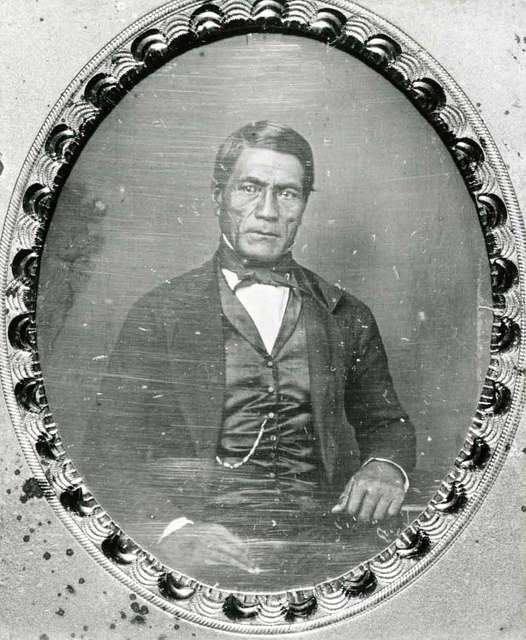 Ioane II (John Papa) was born on August 3, 1800 in Kūmelewai, Waipiʻo – Oahu. He was raised in the traditional Kapu system and trained from childhood for a life of service to the chiefs. At the age of 10, Ioane was taken to Honolulu, where he became a companion and personal servant to Prince Liholiho, later King Kamehameha II. There he underwent a period of training in governance and in the ancient religious rites. As an influential member of the court of Kamehameha III. In 1842 he was appointed by the king to the Treasury Board. He was then a member of the Privy Council 1845–1859 and in 1846 he was appointed to the Board of Land Commissioners. ʻĪʻī served in the Legislative Assembly of the Kingdom of Hawaii (Legislature of the Hawaiian Kingdom, House of Nobles) from 1841 to 1870. In 1852 he represented the House of Nobles in the process of drafting the Constitution and became Speaker of the House of Nobles. He then served as a member of the House of Representatives during the 1855 term. He served as a Superior Court Judge from 1848, and as an Associate Justice of the Supreme Court of the Kingdom from 1852 to 1864. ʻĪʻī died of scarlet fever at Mililani, his Honolulu residence, on May 2, 1870.
 Tales of Hawai'i