Lord Edward Russell R.N. is the second son of John Russell, 6th Duke of Bedford (1766-1839) and his second wife Lady Georgina Gordon, who gave birth to him on April 24, 1805.
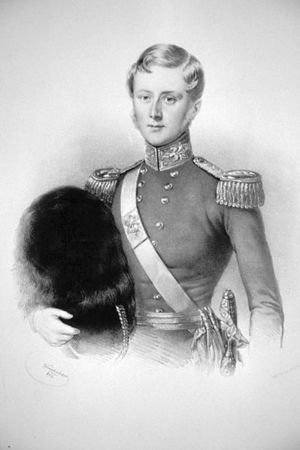 Lord Edward chose a naval career and joined the Navy on January 13, 1819. His career progressed quickly and he became a lieutenant on October 18, 1826, where he was involved in the Greek War of Independence in Philomel. Two years later he became commandant and after another five years he became captain where he then served in South America and the Pacific for the English Crown’s exploration of Polynesia.
During this time Lord E. Russell undertook a voyage on the H.M.S. Actaeon with Captain Biddlecombe to Hawaii, among other places.
The Kingdom of Hawaii encountered land ownership disputes with the steadily arriving foreigners and missionaries. The land belongs solely to the King of Hawaii and only he has the right to rent part of the land to foreign residents and the Hawaiian King also has the right to refuse certain foreigners permission to enter the Hawaiian Kingdom. This was not understood by the missionaries and the western newcomers and created discord and disputes. There were also differences of opinion in faith. The missionaries complained that they could not practice their own faith in their new country of Hawaii. The missionaries refused to teach the locals their Catholic faith. The two priests who were exiled to California in 1835 received a letter from the former Pope in which he warned them to persist in their attempt to establish a mission in Hawaii. On September 30, 1836, the Irish speaker Robert Walsh, who was trained in Paris, arrived in Honolulu from California on the brig “Garafilia” from Valparaiso. He was ordered to leave Hawaii again. But through the intervention of the British consul, he was patiently allowed to stay with Lord Edward Russell until the British sloop “Acteon” arrived.
On October 28, 1836, Lord Edward Russell arrived in Hawaii and, after a long and cordial discussion with King Kamehameha III about the missionary and land disputes, negotiated a convention. On November 16th of the same year, this treaty was signed, which defined the right of the British subjects to land, reside and build houses on the islands with the consent of the king.
After this signing and conclusion of the treaty of friendship with Kamehameha III on November 16, 1836, Edward Russell sailed on to Tahiti. After a short stay there, they later sailed to the Tuamotu Archipelago, where they found unknown islands. This Lord E. Russell named the Actaeon Group after his ship on January 3, 1837, although the discovery is attributed to Captain Thomas Ebril of the Tahitian merchant ship Amphitrite (1833).
For Captain Ebrill had informed Captain Biddlecombe and Russell, while in Tahiti, that some information in the Tuamotu Archipelago was not recorded on the charts, and it is probable that this group of four islands is included in this report of Russell’s. However, only three low, wooded islands have been sighted and charted in Captain Biddlecombe’s archipelago. Russell named these islands Bedford, Minto and Melbourne. From west to east the four islands are: Tenararo, Vahanga, Tenarunga and Matureivavao. However, on Biddlecombe’s map, the middle island is the largest catographed, while Maturei-vavao, the easternmost and southernmost, is actually the largest island. It is possible that Ch. Biddlecombe had viewed the two middle islands of Vahanga and Tenarunga as one overlapping stretch of land rather than as two islands. Therefore the westernmost, which was called Bedford, would correspond to Tenararo; the two middle ones on Minto; and the remaining island of Maturei-vavao to Melbourne. Melbourne is shown on modern maps as an alternative name of Maturei-vavao and Minto as Tenarunga. After mapping, the Actaeon sailed on to Pitcairn, and there the short communication in the Journal of the Royal Geographical Society ends.
 Lord Edward Russel’s career continued and he was appointed Rear-Admiral on October 17, 1856, Vice-Admiral in the spring of 1863, and Admiral on March 26, 1867. In 1870 Lord Edward was able to retire as a retired admiral. On February 8, 1860, Edwin Russell married Mrs. Mary Ann Taylor. E. Russell was not only a British naval officer but also a respected politician and member of the House of Commons. E. Russell, died on May 21, 1887 at the Royal Yacht Squadron Castle in Cowes.
English Treaty of Lord Edward Russell, November 16, 1836
ARTICLES made and agreed on at Honolulu, Island of Oahu, the 16th of November, 1836
ARTICLE I. English subjects shall be permitted to come with their vessels, and property of whatever kind, to the Sandwich Islands; they shall also be permitted to reside therein, as long as they conform to the laws of these Islands, and to build houses, and warehouses for their merchandize, with the consent of the King, and good friendship shall continue between the subjects of both countries, Great Britain and the Sandwich Islands.
ARTICLE II. English subjects, resident at the Sandwich Islands, are at liberty to go to their own country, or elsewhere either in their own or any other vessel; they may dispose of their effects, enclosures, houses, &c., with the previous knowledge of the King, and take the value with them, without any impediment whatever. The land on which houses are built is the property of the King, but the King shall have no authority to destroy the houses, or in any way injure the property of any British subject.
ARTICLE III. When an English subject dies on the Sandwich Islands, his effects shall not be searched or touched by any of the Governors or Chiefs, but shall be delivered into the hands of his executors or heirs, if present but if no heir or executor appear, the Consul or his agent shall be executor for the same; if any debts were owing to the deceased, the Governor of the place shall assist and do all in his power to compel the debtors to pay their debts to the heir or executor, or the Consul, in case no heir or executor appears, and the Consul is to inform the King or the death of every British subject leaving property upon the Sandwich Islands.
KAMEHAMEHA III,
EDWARD RUSSEL,
Captain of H. B. M.’s Actcon.

More Infos:
- div. Orginal Documents of 1836 (inkl. Edward Russell & King Kamehameha III)
- Edward’s father John Russell
- John Russell
 Tales of Hawai'i