Go direct to:
| Contract | more Infos | Poster Contract |
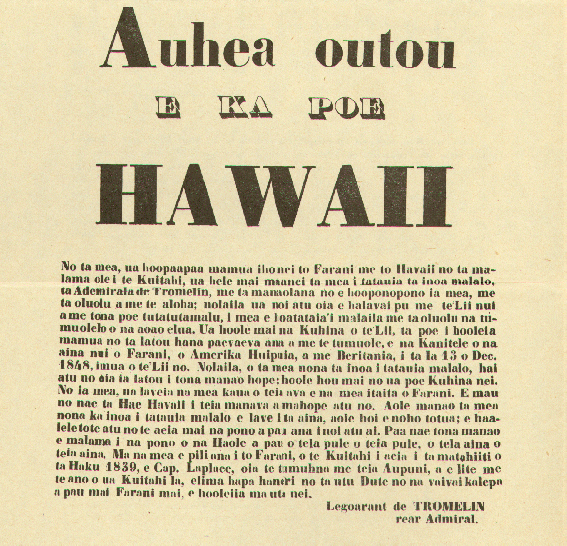
From 1826 onwards, France slowly but steadily expanded into the Pacific. Many Catholic missionaries left France because of domestic politics and war and reached the Hawaiian Islands, where they were rather excluded by the Protestant-converted Hawaiian leaders. They, the Hawaiians, also tried to ban Catholicism. The emigrated settlers received little support for Catholic missionary work from Paris until 1839 when Captain Laplace imposed freedom of belief and religion on the Sandwich Islands as well as favorable tariffs on French products, especially spirits and wine. This angered the Hawaiians and led to great tension between the Hawaiian Kingdom and France. During this time, an increasing number of French warships appeared off the Hawaiian coast to mark the presence of France and to remind Hawaii of religious freedom. France expanded extremely further in the Pacific and placed the French flag on the Marques Islands in 1842. De Petit-Thouars imposes French protectorate on Tahiti. Likewise, the French consular in Honolulu wanted to establish the French protectorate over Hawaii. However, as a result of France’s actions with Tahiti, relations in Europe between England and France deteriorated. In order to restore peace between the two countries, the French and English governments have mutually committed themselves to respecting the independence of the sandwiches. France was very present in the Hawaiian Islands from 1843 to 1859 to defend the interests of its missionaries and whaling. The already negotiated treaty of 1839, which provoked several French interventions through endless discussions between the Hawaiian Kingdom and France, was replaced by the subsequent general treaty in 1846. It is a simple treaty that replaces conventions previously agreed between France and Great Britain with the Sandwich Islands. It refers (equally between the two foreign nations of Great Britain and France):
- the protection of civilians and their property (on an equal footing with indigenous subjects);
- the protection afforded to ships;
- Authorization to import any goods with a maximum ad valorem tax of 5%;
- Alcohol, for which the tax may be higher but “reasonable”, which does not make its importation prohibitive.
This treaty was only ratified and mutually exchanged by both sides on March 6, 1848. Franco-Hawaiian relations persist between demonstrations of force and a new treaty (1857). France slowly withdrew after 1859 after two years of a new treaty, gradually ceding control of the archipelago to the United States.
 Treaty of friendship between France and Hawaii in 1846
Treaty of peace, amity, and commerce between France and the Sandwich Islands, signed at Honolulu, March 26, 1846Time having shown the expediency of substituting a general treaty for the various conventions mutually concluded heretofore by France and the Sandwich Islands, the French and Hawaiian Governments have mutually agreed upon the following articles, and have signed them, after acknowledging and decreeing that all other treaties and conventions now existing between the contracting parties, shall be hereafter considered as void and of no effect.
ARTICLE 1.
There shall be perpetual peace and friendship between His Majesty the King of the French and the King of the Sandwich Islands, and between their heirs and successors.
ARTICLE 2.
The subjects of His Majesty the King of the French, residing in the possessions of the King of the Sandwich Islands, shall enjoy, as to civil rights, and as regards their persons and their property, the same protection as if they were native subjects, and the King of the Sandwich Islands engages to grant them the same rights and privileges as those now granted, or which may be granted hereafter, to the subjects of the most favored nation.
ARTICLE 3.
Any Frenchman accused of any crime or offense shall be tried only by a jury composed of native residents, or of foreigners proposed by the consul of France, and accepted by the Government of the Sandwich Islands.
ARTICLE 4.
The King of the Sandwich Islands will extend his protection to French vessels, their officers and crews. In case of shipwreck, the chiefs and inhabitants of the various parts of the Sandwich Islands must lend them assistance and protect them from all pillage.
The salvage dues will be settled, in case of difficulty, by umpires appointed by both parties.
ARTICLE 5.
Desertion of sailors employed on board French vessels, will be severely repressed by the local authorities, who must use every means at their command to arrest the deserters. All expenses, within just limits, incurred in their recapture, will be refunded by the captain or owners of the said vessels.
ARTICLE 6.
French goods, or those recognized as coming from French possessions, can not be prohibited nor subjected to a higher import duty than five per cent ad valorem. Wines, brandies and other spirituous liquors are excepted, and may be subjected to any just duties which the Government of the Sandwich Islands may think proper to impose upon them, but on condition that such duty shall never be high enough to become an absolute obstacle to the importation of the said articles.
ARTICLE 7.
Tonnage and import duties and all other duties imposed upon French vessels, or upon merchandise imported in French vessels, must not exceed the duties imposed upon the vessels or merchandise of the most favored nation.
ARTICLE 8.
The subjects of the King of the Sandwich Islands will be treated upon the footing of the most favored nation in their commercial or other relations with France.
Made at Honolulu, March 26, 1846.
[L.S.] Em. Perrin,
Consul of France,
Charged with a special mission to the Sandwich Islands.
[L.S.] R. C. Wyllie,
His Hawaiian Majesty’s Minister of Foreign Relations.
The Signatories
R. C. Wyllie
 Robert Crichton Wyllie (October 13, 1798 – October 19, 1865) was a Scottish physician and businessman. He served for twenty years as Minister of Foreign Affairs in the Kingdom of Hawaii.
To the original documents
- Dokumente Archiv 1790 -1849
- Admirala de Tromelin, France 1849
- Documents between Frankreich, Tahiti & Sandwich Island
- List of French Diplomatss in Hawaii
- Charles de Varigny
- Artikel „La France et les Français aux îles Hawaii au XIXe siècle“
Poster
Friendship Treaty between Hawaii, Frankreich und England 1848

 Tales of Hawai'i